Sample issue. The next one is in your inbox before 8am, free.
Get Early WireZaner Early Wire
Headlines
- China urges swift implementation of $60 billion U.S. tariff-cut deal to pave way for additional American agricultural purchases
- Bloomberg reports China booking French and Argentine wheat as U.S. exporters await fresh Chinese purchases
- CBOT wheat emerges from oversold territory for first time since Oct. 20 as Ukrainian drone strike hits Russian port infrastructure
- U.S. dollar hits 19-month high as Fed rate hike expectations grow, making American agricultural exports less competitive globally
Price Recap
| Symbol | Name | Open | High | Low | Close | Change | Volume | Date |
|---|---|---|---|---|---|---|---|---|
| ZCZ26 | Corn | 449.50 | 450.75 | 443.25 | 448.00 | ▼ -1.50 | 256,044 | 2026-11-11 |
| ZSF27 | Soybean | 1,227.50 | 1,236.00 | 1,218.75 | 1,230.75 | ▲ +3.25 | 139,113 | 2026-11-11 |
| ZWZ26 | Wheat | 592.50 | 603.75 | 589.50 | 599.50 | ▲ +7.00 | 131,030 | 2026-11-11 |
Chart of the Day
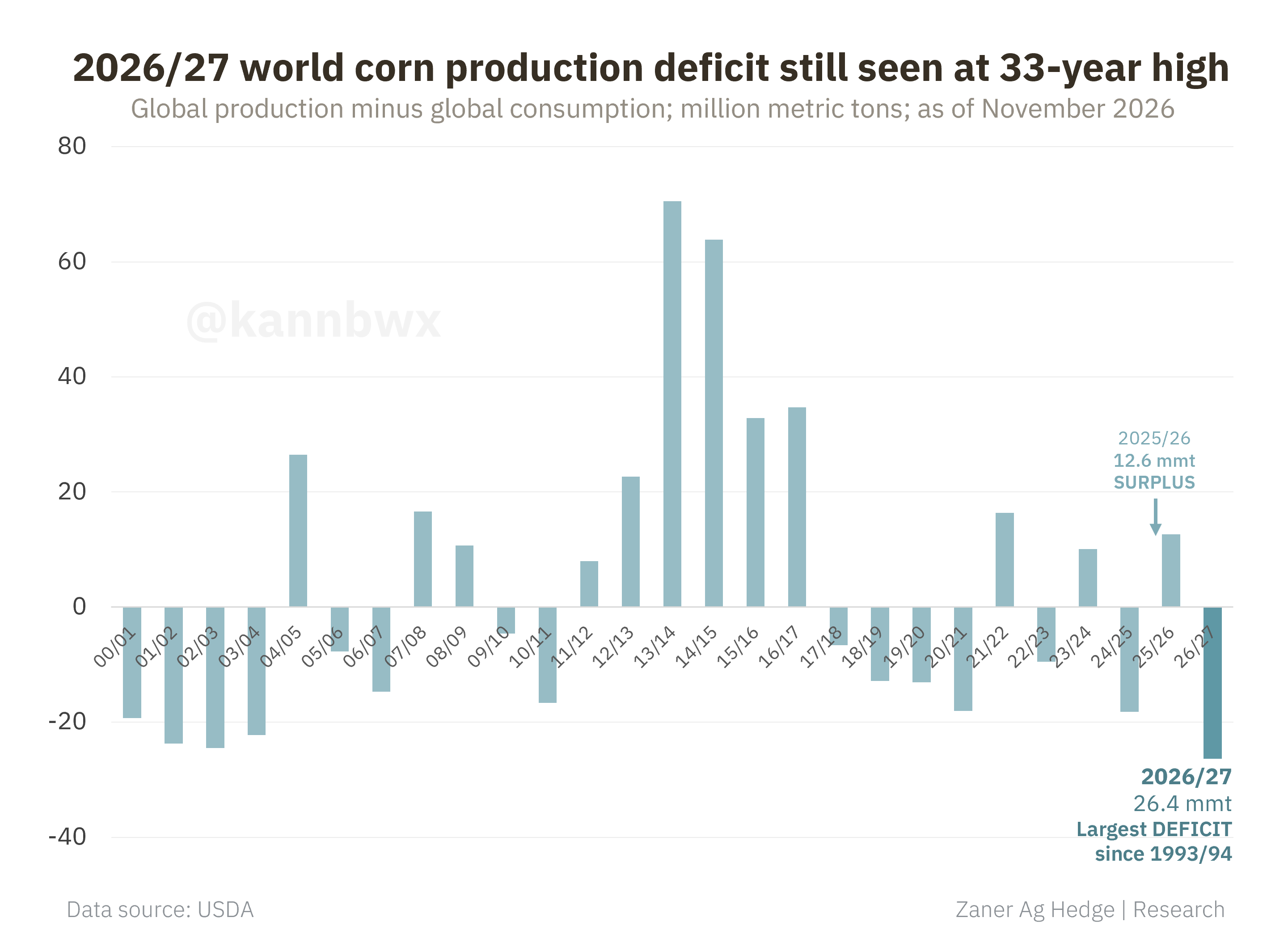
Global corn consumption is forecast to exceed production by 26.4 million metric tons (1.04 billion bushels) in 2026/27, the largest deficit in 33 years, according to USDA's November estimates. That marks a sharp reversal from the 12.6 million-ton surplus (496 million bushels) in 2025/26, despite expectations for another massive U.S. harvest.
Zaner Ag Hedge Team
Strategy of the Week
January soybeans have rebounded more than 40 cents off the recent low on the back of the November WASDE report that was bullish vs expectations. Funds are still long soybeans, but if there isn't an issue with the South American crop, they could chose to liquidate. This is a way to protect the downside while retaining upside potential to sell cash higher.
Strategy: Buying the January Soybean 1200 put for 12 cents (plus fees).
This is a price floor strategy based on January futures. It expires on 12/24. If January soybeans are trading below 12.00 per bushel at expiration, this strategy would execute and turn into a short January futures position at 12.00. It can also be exited any time. It's intended as a hedge strategy on unsold bushels, or as a speculative trade.
Speak with your Zaner professional to discuss what action might be best for you.
Zaner Ag Hedge Team
Feel From the Farm
Field activities will draw to a close quickly around west-central Indiana. This has been a busy week for local retailers applying lime and dry fertilizer products thanks to favorable weather conditions. There has been some fall anhydrous applied, although not nearly as much as I've seen in past years. On our farm, we've used some of the warmer days for washing equipment, prepping for colder weather, and starting to put together a crop plan for next year. Basis numbers continue to firm with very little grain movement at this time. Bids get better to the east and west of us as you find more processing in those locations, but their bids are strong enough that it's firming up our local bids.
Zaner Ag Hedge Team
Corn
Corn struggles to make substantial gains after USDA report
December corn finished Wednesday in a relatively narrow range while soybeans and wheat managed to close higher. A sharply stronger U.S. dollar created a headwind for grain prices, making American supplies less competitive in the export market. Corn has struggled to attract sustained buying interest even with improving sentiment across parts of the grain complex.
Ethanol demand remains a supportive factor. The latest EIA figures showed production averaging 1.143 million barrels per day, up 25,000 barrels/day from the previous week and 2% above year-ago levels. Ethanol inventories also declined slightly to 24.434 million barrels, while exports increased 27% from the prior week. These figures indicate solid processing activity and continued demand for corn from the ethanol industry. Corn continues to find support from the smaller production estimate, but traders are looking for stronger buying interest before becoming more optimistic.
December corn continues working around the $4.50 per bushel level. Wednesday's low at $4.43-1/4 is nearby support, while $4.50-3/4 is the first area of resistance. A sustained move above $4.50 would help improve the short-term chart.
Zaner Ag Hedge Team
Soybeans
Brazil exports increase for November. Fund trader bailing on recent short trades?
Wednesday, January beans traded higher on the day. Weakness on the open was ultimately met with buying that took the market to a high of $12.36 per bushel, closing at $12.30-3/4, up 2.75 cents. No flash sales Wednesday morning due to Veterans Day. Export sales will be pushed to Friday as well. Strength in the U.S. dollar continued Wednesday, which some feel makes beans' ability to close above Tuesday's high that much more impressive. ANEC estimates Brazil exports for November at 4.37 million metric tons, up 1.04 million metric tons from its last update.
What are the funds going to do? Price action after the dip on the open felt like fund short covering. With Wednesday's holiday, I would not be surprised to see another round Thursday when bank participants return. The market traded above the 18-day moving average (1232-1/2) but was unable to close above it. Technical traders, likely selling against the 18-day, will need a close above $12.42 per bushel to give up ideas of being short.
Zaner Ag Hedge Team
Wheat
Talks conclude, no breakthroughs announced, technical small steps may be short covering
Wednesday, Chicago wheat for December traded higher. Weakness on the open was met with buying (possibly short covering), taking the market to a high of $6.01 per bushel near the overnight high of $6.03. The low trade was $5.89-1/2, closed at $5.99-1/2, up 6.75 cents. Trilateral talks concluded without breakthroughs or shipping guarantees. SovEcon sees Russian exports declining 700,000 metric tons to 36 million metric tons. USDA recently revised its forecast to 39 million metric tons. SovEcon also doesn't see the chance for normal shipping in the Black Sea until spring of 2027. Here in the U.S., forecasts call for above-normal precipitation in winter wheat growing areas for the second half of November.
Thursday's volume of 120,062 contracts traded and a close above the 10-day moving average (598-1/4) suggest short traders with tight technical stops heading for the sidelines. Some feel war premium could return now that talks have ended. 18-day moving average (607) and recent swing high of $6.06-1/2 per bushel stand between here and further discussion of a near-term bottom.
Zaner Ag Hedge Team
Cattle
Cattle futures mixed after rebound; eastern Iowa bids $210 as cash stays quiet
Live cattle futures closed mixed after a two-day rebound from multi-month lows. December settled at $218.98 per cwt (down 0.22), February at $222.70 (up 0.13). Feeder cattle were mostly higher, with November at $332.63 (up 2.27). The market is trying to base after last week’s sharp sell-off.
Cash trade stayed quiet. Only 74 head sold at $210, and in eastern Iowa there was a $210 bid Wednesday. Last week’s negotiated trade dropped sharply, with northern live sales mostly $208–$218 and dressed $330–$340. Southern trade held nearer $218. Box beef declined on 95 loads: Choice down $2.72 to $360.26, and Select down $4.15 to $347.47. Estimated slaughter was 107,000 head. Packer margins improved markedly. Corn was slightly lower. Near-term tone is cautious as the market watches whether cash confirms the futures bounce.
December futures: 220.75 and 223.57 are resistance.
Zaner Ag Hedge Team
Energy & Equities
Crude oil recovered Wednesday after two sessions of heavy selling as renewed shipping incidents near the Strait of Hormuz weakened hopes for an immediate U.S.-Iran agreement. December WTI was up 49 cents, settling at $86.53, while January Brent gained $1.27 to $92.76. Iran's declaration that it would retain its enriched nuclear material added to doubts about a quick diplomatic resolution. The latest EIA report offered some underlying support for energy markets. Crude inventories fell 865,000 barrels, gasoline stocks declined 222,000 barrels, and distillate inventories dropped another 3.565 million barrels to 99.3 million. Distillate supplies are now approximately 13% below the five-year average, highlighting continued tightness in the diesel and heating-oil markets.
Equities staged a strong recovery. The Dow gained 0.5%, the S&P 500 gained 1.3%, and the Nasdaq jumped up 1.6%. Strong results from CoreWeave helped restore confidence in AI-related spending, lifting technology and semiconductor shares after last week's heavy selling. Investors will look for further confirmation that demand for AI infrastructure can support the enormous investment being made.
Zaner Ag Hedge Team
Weather
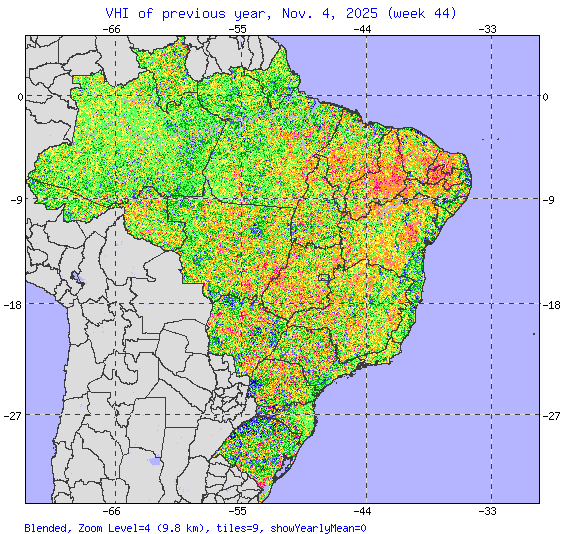
Below are Vegetative Health Index maps for Brazil, with the top map reporting this year and the bottom map showing how things looked a year ago. It definitely reflects the southern bias of rainfall for their growing season so far. Mato Grosso showing a little more stress than last year, while better vegetative scores are seen in the east and south in areas like Goias, Minas Gerais, Rio Grande do Sul and São Paulo. Rain forecasts for the next two weeks favor the central areas where it's been a little drier. Temperatures for the short term look nonthreatening. 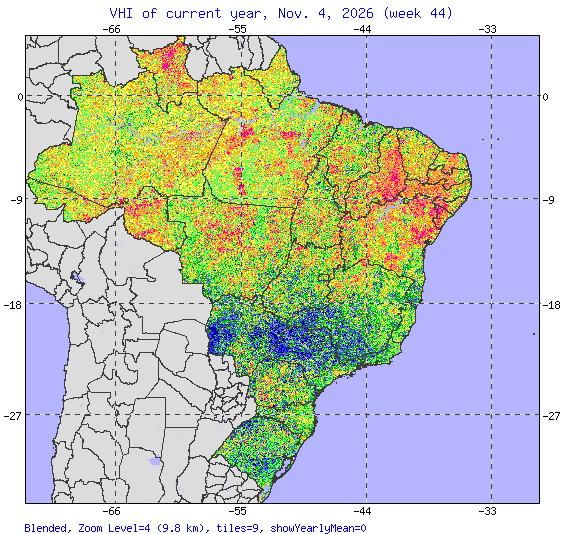
Zaner Ag Hedge Team
Like what you read? Get tomorrow’s issue free.
Get Early Wire